

Running intervals – what are they and how does interval training work?
You run, run and run, yet paradoxically your results have seemed stuck in the same place for quite a while? The reason you are not making progress may lie in monotony, or more precisely – in not dividing your workouts into ones with different levels of intensity.
What can you do to get things moving? The answer may be interval runs, which will add variety to your current training plan and, above all, help you start improving your results.
Learn the definition of interval running, find out what it does, and how you can start using it in your training.
What is an interval? What role does it play in sport?
Interval runs, commonly referred to simply as intervals, involve skillfully combining two types of exercise.
- First – those of very high intensity (e.g. running for several dozen seconds at 80–100% of your capacity).
- Second – those of moderate or very low intensity (e.g. several dozen seconds of walking or slow jogging).
This kind of “mix” helps build a foundation for better fitness, endurance and, as a result, better performance (both during your next training sessions and in races themselves).
Of course, this type of activity can take different forms. There are, among others, exercises that can be done directly at home (e.g. on a treadmill, stationary bike, elliptical trainer, with a jump rope, or even other equipment). However, due to the title of this article, in the following part we will focus mainly on the most traditional form of interval training – running.

How can you tell whether an interval really is an interval?
You will recognize it by 2 aspects:
- On the one hand, if you feel that a given set (e.g. covering a section quickly) really pushed you hard, you are struggling to catch your breath and you feel overall fatigue – that may be a clear sign that you have completed an interval.
- On the other hand, if you wear a watch with heart rate monitoring, you can use specific measurements. You will know it when your device shows that you reached 90% (or more) of your maximum heart rate.
What can running intervals look like?
Interval training should take 2 key factors into account.
First – your experience and overall predispositions. If you are just starting your running journey, do not jump in at the deep end and begin rather with simple short runs. There will still be time for harder training sessions. Our guide will help you with that: How to start running?. If you already have many kilometers behind you, and running 5 or 10 km does not make you think “Why so far?!” – that may be a sign that intervals are for you :).
Second – your goals. You need to remember that enriching your plan with interval runs is meant to add variety to the effort your body is exposed to. Simply put: you do it to improve your performance. If you do not have particularly ambitious sports goals and from time to time you simply like to go for an easy jog, intervals may not be the best option.
How to run? Exercise examples.
Below we present a few suggestions. Keep in mind that these are only sample options that can be modified and, most importantly, adjusted to your predispositions. We distinguish short, medium and long intervals:
Distance intervals, meaning those in which you focus on covering a specific distance at the fastest possible pace. Below are a few suggestions for each type of training:
- Short: a run over 50–100 meters, followed by a 50–100 m jogging break (they are easiest to do on a track).
- Medium: a run over 200–500 meters, followed by a 100–200 m jogging break.
- Long: a run over 1–3 kilometers, followed by a 500–1000 m jogging break.
Time intervals, meaning those in which you focus on maintaining the fastest possible pace over a set period of time.
- Short: run for 30–45 seconds, followed by a 30–60 second jogging break.
- Medium / long: run at a pace 10–20 seconds faster than your target race pace, followed by a 30–60 second jogging break.
Each of them should be performed in sets (from 3 up to as many as 8 in one session).
Remember: every workout should start with a warm-up that prepares your body for increased activity and, most importantly, helps protect you from (or at least reduce the risk of) injury or other damage. The maximum duration of such exercises should range from 25 to 45 minutes (depending on your capabilities).
Intervals are not for everyone. When is it better to skip them?
As we mentioned, due to their high intensity, this kind of activity is not recommended for people who are just beginning their running journey.
In addition, people who are ill (suffering from hypertension, having heart problems, or even circulatory system issues) and people with obesity should avoid this type of training (because it may lead to injury).
Why is it worth it? What does interval training do?
Are you wondering whether this kind of effort is really “worth it”? Thanks to properly planned and performed intervals:
#1 You improve endurance
You improve the work of your heart, circulatory system, lungs and even muscles. All of this translates into better sports performance and an overall improvement in your fitness.
#2 You speed up fat burning
Intense effort helps you burn calories and additionally provides great support for your metabolism.
#3 You feel better
Intense exercise releases a powerful dose of dopamine, which puts you in a great mood after training.
How often should you run intervals?
In this case, moderation and skillfully fitting this type of activity into your overall training schedule are very important. Because this form of running clearly puts strain on practically your whole body (muscles, nervous system, etc.), it is best to do intervals once, at most twice a week.
The frequency of such runs should be adjusted to your training background, experience, skills and overall condition.
- Intervals for beginners and intermediate runners: if after each such session you feel very tired, and the next day you have trouble moving normally – that may be a sign that 1 workout per week is completely enough.
- Intervals for advanced runners: if you take it quite seriously, this kind of training unit may appear in your plan up to 2 times a week.
What sportswear works best for interval runs?
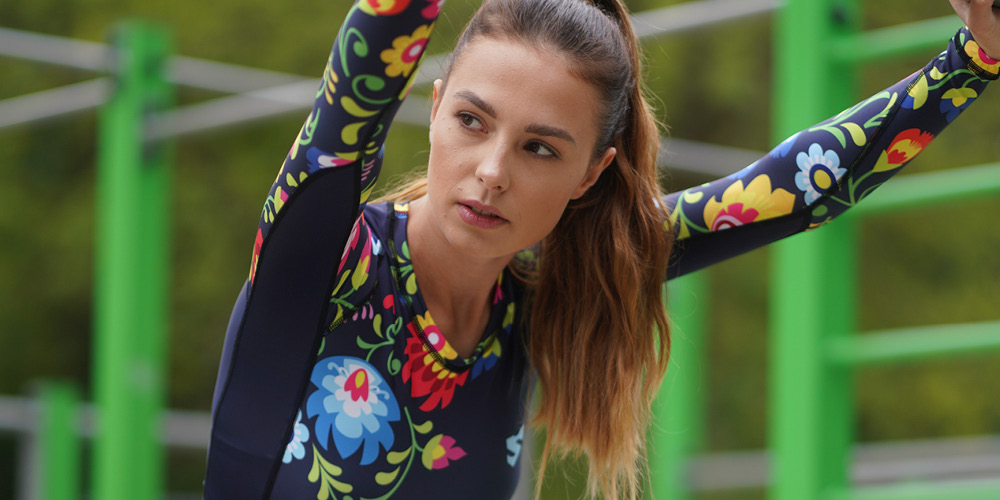
Due to their nature (read: short, but fast and very intense effort), it is best to choose clothing that is flexible, does not restrict movement, gives you full freedom, and also fits the body very well.
That is why rashguards and leggings work very well in this role. For women, fitted tank tops are also a great option. You can find all of them in our SMMASH online store.


